

How do we perform zero adjustment for the reinforced concrete drainage pipe pressure testing machine?
Release Date:
2022-06-30
How do we perform zero adjustment on a reinforced concrete drainage pipe pressure testing machine? For many years, testing machines have been widely used in mechanical performance experiments such as axial tension, contraction, and bending of metal materials, as well as compression and bending tests of ordinary building materials. How do we perform zero adjustment on a reinforced concrete drainage pipe pressure testing machine?
How do we perform zero adjustment on the reinforced concrete drainage pipe pressure testing machine?
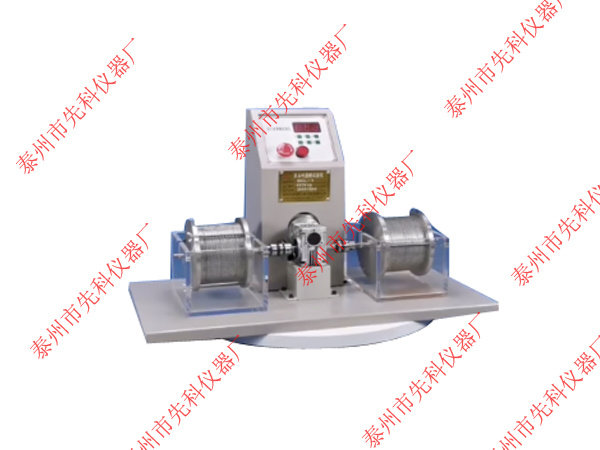
For many years, the testing machine has been widely used in mechanical performance experiments such as axial tension, contraction, and bending of metal materials, and also in compression and bending tests of ordinary building materials. How do we perform zero adjustment on the reinforced concrete drainage pipe pressure testing machine?
1. Zeroing of the percentage table pointer hydraulic (swing) universal testing machine: For example, the WE-B series digital hydraulic universal testing machine, its task principle also uses hydraulic loading principle. Before the test, according to the ultimate load of the specimen, select the appropriate dynamometer and configure the corresponding swing. To adjust the zero position of this testing machine, the oil pump must first be started, allowing the task piston to rise an interval of (10~20) mm before stopping, and then the gear rack is rotated to return the pointer to zero.
2. Zeroing of the pointer-type (swing-type) pressure testing machine: This type of pressure testing machine is mainly used for the compressive strength test of cement specimens. Its task principle uses hydraulic loading principle, and the load acting on the sample is accurately indicated by the indicating mechanism, using a tangent swing force measuring mechanism. Before the experiment, according to the ultimate load of the specimen, select the appropriate dynamometer and configure the corresponding swing, so that the pointer points to zero. When zeroing, start the oil pump motor, close the return oil valve, open the oil supply valve, and let the piston rise (10~20) mm, so that the external resistance is in a balanced state, and then gently rotate the screw by hand to make the pointer point to zero.
3. Zeroing of the microcomputer-controlled electronic universal testing machine: This type of universal data testing machine uses a motor-driven ball screw to apply force, and a high-precision strain gauge force sensor to measure force. Before zeroing, it is not necessary to raise the task platform for a period of time, nor is it necessary to adjust the zero balance of the force measurement. Only the zeroing knob (or mouse) of the testing machine can adjust the initial force to zero.
4. Digital zeroing, on-screen pressure, universal material testing machine: This type of testing machine is widely used at present. It uses a force sensor to measure force, and the force value is displayed digitally. Only through the adjustment key can the initial force be displayed as zero. Since this type of testing machine is still driven by a hydraulic cylinder pushing the task piston, the oil pump needs to be started before zeroing to lift the task piston (10~20 mm). If the oil pump is not started to raise the task piston for a period of time before zeroing, the experimental force will be added, resulting in a large experimental error.
5. Zeroing of the microcomputer-controlled electro-hydraulic servo universal material testing machine: This type of universal material testing machine uses a force sensor to measure force. The force sensor is powered by the main machine oil cylinder, so the oil pump must be started before zeroing, and the task piston must be raised (10~20) mm before stopping. The measuring range of this testing machine is divided into several levels. When the measuring range is set to zero, the measuring range should be set to a low level. Then, by setting the experimental force to zero, the experimental force should be displayed as zero, and then the adjustment of the experimental force full scale of this measuring range should be stopped. If this testing machine imitates the display of the dial, the initial force and weighing force displayed on the screen should be adjusted to be different from those displayed on the dial.
Related News

Service Hotline
Email:jyxkyq@163.com
Address: Sanlin Industrial Park, Liangxu, Jiangyan District, Taizhou City, Jiangsu Province
Copyright © 2025 Taizhou Xianke Instrument Factory